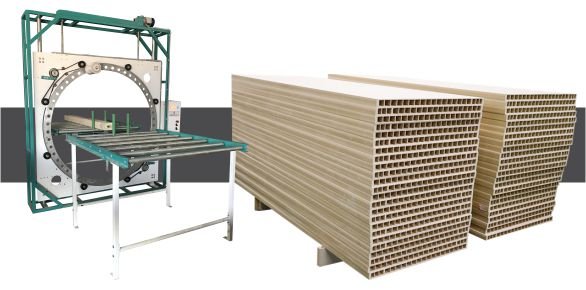
Product Extra DetailThe Rotating Ring Wrapping Machine is an industrial packaging system designed to wrap pipes, bars, and bulky industrial products with stretch film or protective laminates. It ensures uniform coverage, edge protection, and secure handling, minimizing surface damage during storage, transport, or dispatch.
Manufacturers and warehouses use it to replace manual packing, reduce labor, and maintain consistent, export-grade packaging for long or heavy items.
How It Works: Step by Step
Product Loading
Operators or conveyors place the pipes, bars, or bulky items onto the infeed platform or rollers.
Alignment & Positioning
The machine aligns the product in the center of the rotating ring to ensure balanced, uniform wrapping.
Film Feeding & Tension Control
Stretch film passes through a pre-stretch or tensioning system, optimizing material usage and preventing surface damage.
Rotating Ring Action
The ring rotates around the product, wrapping it while either the product or ring remains stationary. This ensures complete coverage of edges, corners, and irregular shapes.
Film Cutting & Sealing
Automatic cutters finish the wrap, securing the film neatly and eliminating manual intervention.
Outfeed & Dispatch
The wrapped product exits the machine, ready for palletizing, storage, or shipping.
Importance in Modern Industrial Operations
Handles long, heavy, and bulky products safely and consistently
Reduces manual labor and human error
Provides uniform, protective wrapping for high-value products
Prevents surface scratches, dents, and dust contamination
Improves logistics efficiency and storage safety
Automating wrapping ensures high throughput, lower operational costs, and consistent quality, critical in modern industrial operations.
How to Choose the Right Model
Capacity: Match machine speed and throughput with production needs
Product Size & Weight: Select appropriate rollers, supports, and motor strength
Material Type: Ensure compatibility with stretch film, foam, or protective sheets
Automation Level: Choose manual, semi-automatic, or fully automatic based on production scale
Budget & ROI: Consider labor savings, reduced damage, and material efficiency
Factory Layout: Choose horizontal or vertical orientation depending on space
Conclusion
The Rotating Ring Wrapping Machine delivers efficient, safe, and uniform packaging for pipes, bars, and bulky industrial products. It reduces labor, minimizes damage, improves material efficiency, and is essential for manufacturers seeking high-quality, automated, and export-ready packaging solutions.
FAQs
1. What is a Rotating Ring Wrapping Machine?
It is an industrial machine designed to wrap pipes, bars, and bulky industrial products using stretch film, foam-laminated sheets, or protective films, ensuring uniform coverage and surface protection.
2. How does the machine work?
The machine aligns the product, feeds film with controlled tension, rotates a ring around the product to wrap it completely, cuts and seals the film automatically, and discharges the wrapped product ready for storage or shipment.
3. What types of products can it wrap?
It can wrap steel bars, pipes, wires, construction materials, machinery parts, and other long or bulky items efficiently.
4. What are the energy and power requirements?
Voltage: 380–415V, 3-phase, 50/60 Hz
Power Consumption: 3–7 kW depending on model
Pre-stretch film and automated tension control ensure low energy usage per product.
5. How does automation affect productivity?
Manual: Operator wraps products manually; suitable for low-volume operations
Semi-Automatic: Operator loads products; machine wraps automatically; suitable for medium-volume production
Fully Automatic: Conveyor-fed; minimal human intervention; ideal for high-volume operations
Automation increases throughput, reduces labor, and ensures consistent wrapping quality.