Product Extra DetailWhat the Product Is and How It Works
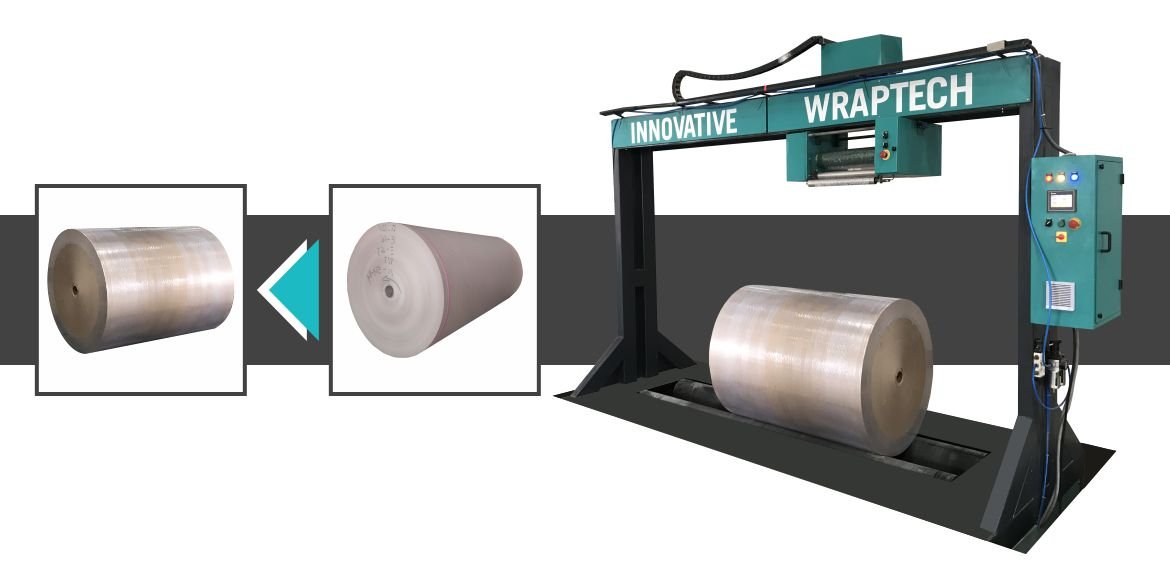
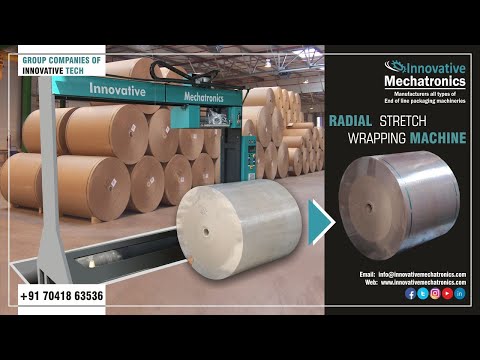
The Machine Roll Stretch Film is a high-performance industrial solution designed to wrap rolls of paper, textiles, and other cylindrical products using stretch film. It protects rolls from dust, moisture, handling damage, and edge tears during storage and transportation.
Step-by-Step Technical Operation:
Roll Loading: The operator places the roll on the rotating platform or conveyor system.
Film Feeding: The stretch film is loaded onto the film carriage and threaded automatically.
Tension Control: The machine adjusts film tension to prevent tearing while ensuring tight wrapping.
Rotational Wrapping: The roll rotates while the film carriage moves axially (radial or orbital), covering the entire surface.
Layer Control: The system controls the number of film layers, optimizing material usage.
Film Cutting & Sealing: Once wrapping is complete, the film is automatically cut and sealed for a secure finish.
Roll Discharge: Wrapped rolls are unloaded manually or via a conveyor system for storage or shipping.
This process ensures uniform, high-speed wrapping and minimizes human error, delivering professional-grade packaging every time.
Why This Machine Is Important in Modern Industrial Operations
Modern industrial operations demand speed, efficiency, and product protection. Machine Roll Stretch Film:
Reduces damage to valuable rolls during handling and transport
Saves stretch film through optimized tension and layering
Improves packaging speed, supporting high-volume production
Reduces labor costs, allowing operators to manage multiple machines
Ensures consistent quality, essential for logistics and customer satisfaction
Industries such as paper mills, textile manufacturing, packaging plants, and logistics companies rely on this machine for reliable and cost-efficient operations.
How to Choose the Right Machine
1. Capacity Requirements
Maximum roll diameter, width, and weight
Daily throughput and production targets
Select semi-automatic for moderate volume or fully automatic for continuous production
2. Material Compatibility
Kraft paper rolls, tissue rolls, cardboard, and other cylindrical products
Ensure the machine supports your product dimensions and weight ranges
3. Level of Automation
Manual loading for low-volume operations
Semi-automatic for balanced efficiency and cost
Fully automatic with conveyor integration for high-volume continuous production
4. Budget Considerations
Factor in film savings, labor reduction, and reduced product damage
Professional-grade machines offer long-term ROI, durability, and low maintenance
Energy and Power Requirements
Operates on standard industrial voltage (220–440V AC, 50/60Hz)
Typical power consumption: 1–3 kW, depending on roll size and automation
Low-energy design reduces operational costs while maintaining high efficiency
Frequently Asked Questions
1. What industries use this machine?
Paper mills, textile units, packaging plants, and logistics companies.
2. Can it handle large, heavy rolls?
Yes. The machine is engineered for heavy-duty industrial rolls, ensuring secure and uniform wrapping.
3. Does it save material?
Yes. Optimized tension and layer control reduce stretch film usage, lowering costs.
4. Is it easy to operate?
Yes. Intuitive HMI controls and automated processes require minimal operator training.
5. Can it integrate with conveyors?
Yes. Fully automatic versions integrate with infeed and outfeed conveyor systems.