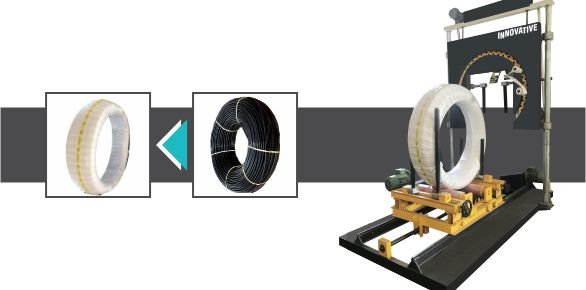
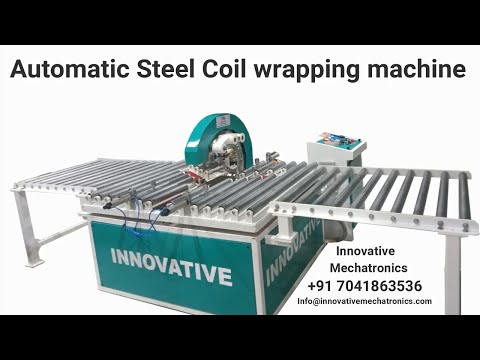
Product Extra DetailThe Lateral Pipe Wrapping Machine is an industrial packaging machine designed to wrap pipes securely and efficiently with stretch or shrink film. It stabilizes pipes during storage, transport, or export and protects them from dust, moisture, scratches, and damage.
Key benefits:
Improves packaging consistency – Each pipe is wrapped uniformly.
Reduces manual labor – Operators no longer manually wrap heavy or long pipes.
Cost-effective – Saves on packaging material and labor expenses.
Supports industrial workflows – Suitable for small, medium, and large-scale pipe manufacturers.
This machine is critical in modern industrial operations because it improves safety, reduces damage, and enhances operational efficiency, all while maintaining low operational costs.
How to Choose the Right Machine
When selecting a Lateral Pipe Wrapping Machine, consider:
| Factor | What to Evaluate | Why It Matters |
|---|
| Capacity | Maximum pipe length, diameter, and weight | Ensures the machine handles your production requirements without downtime |
| Material | Film type: stretch or shrink | Impacts load protection, cost, and wrapping consistency |
| Automation | Manual, semi-automatic, or fully automatic | Higher automation reduces labor requirements and increases throughput |
| Budget | Initial cost and operating expenses | Aligns with ROI and long-term business planning |
| Integration | Ability to connect with production lines or ERP | Supports automation and smart factory workflows |
Choosing the right model ensures maximum productivity, safety, and ROI.
Why Manufacturers Prefer Professional-Grade Machines
Durability: Designed for continuous industrial use without frequent maintenance.
Consistency: Uniform wrapping prevents pipe damage and improves product presentation.
Efficiency: Reduces time per pipe compared to manual wrapping methods.
Future-ready: Can integrate with semi-automatic or fully automatic upgrades for high-volume operations.
Low-cost alternatives often fail under continuous industrial operation, causing downtime, repair costs, and inconsistent wrapping quality.
Safety Standards, Compliance, and Operator Protection
Innovative WrapTech designs the Lateral Pipe Wrapping Machine to meet industrial safety standards:
CE-compliant and ISO-certified manufacturing
Emergency stop buttons for operator protection
Mechanical guarding to prevent accidental contact with moving parts
Stable base and ergonomic controls reduce operator strain
These features protect operators while ensuring compliance with industrial safety regulations.
Frequently Asked Questions
What are the energy and power requirements of the machine?
The Lateral Pipe Wrapping Machine typically requires 220–380V single or three-phase power, depending on model size. Energy-efficient motors reduce operating costs, improving sustainability and ROI.
How long is the expected service life of the machine?
With proper maintenance, the machine can operate reliably for 8–12 years, making it a long-term investment for pipe manufacturers.
What are the common troubleshooting issues and quick fixes?
Film tearing: Adjust tension or replace worn rollers.
Turntable or carriage not moving: Check motor connections or electrical supply.
Uneven wrapping: Inspect carriage alignment and adjust speed settings.
Can the machine be integrated with existing production lines or ERP systems?
Yes. Many models offer optional sensors and PLC integration, enabling connection to conveyor lines, warehouse management systems, or ERP software for automation and smart factory operations.
How does the machine impact labor costs and workforce efficiency?
It reduces the physical effort required to wrap pipes manually, allowing one operator to wrap multiple pipes faster. This reduces labor costs and improves productivity without increasing headcount.