
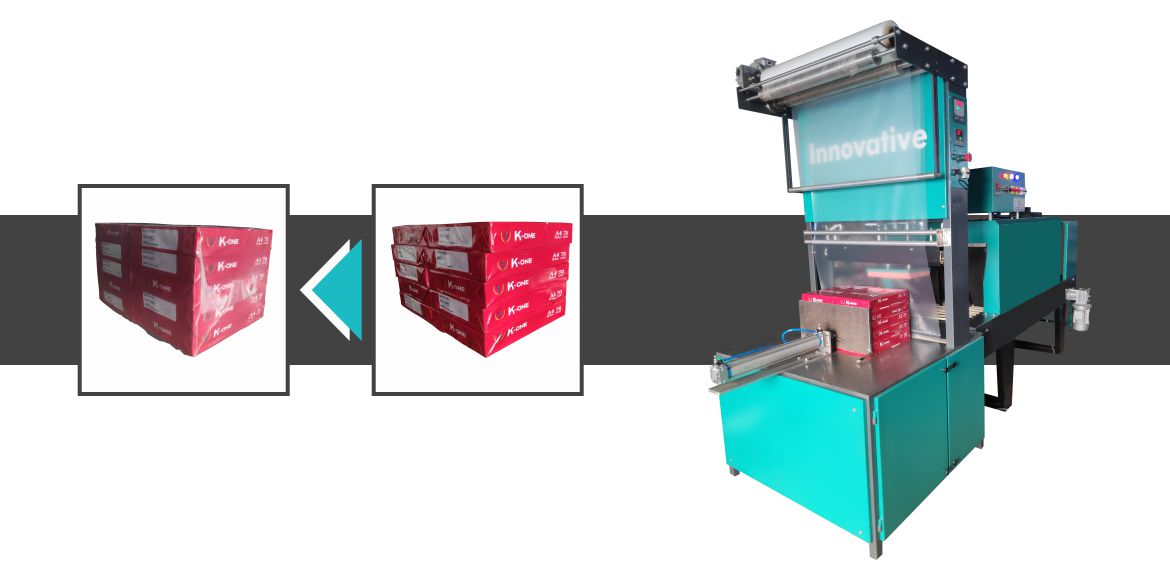
We are presenting fine quality Shrink Wrapping Machine Battery For A4 Paper Bundle Ream with Manual Collation and with partial ‘U’ sealer. These products are developed from the best available technology.
Range:
- Products such as a battery, bottles, tins, cans, boxes, containers, which are available in numerous configurations of 6, 12, 18 or 24 with/without a base tray or with the help of FLAT SHEET at the bottom, could be shrunk wrapped at various speeds of 5-15 packs per minute
- stretch wrapping Similarly stretch packing After that product good looking In addition, I’m recording some video for stretch wrapping machine
Shrink Wrapping Machine for A4 Paper Bundle Ream – Complete Industrial Guide
What is a Shrink Wrapping Machine for A4 Paper Bundle Ream?
A Shrink Wrapping Machine for A4 Paper Bundle Ream is an industrial packaging device designed to tightly wrap multiple A4 paper reams with shrink film, ensuring secure, dust-free, and professional packaging. The machine uses heat to shrink the film around paper bundles, providing uniform coverage and a tamper-proof finish.
Technically, it combines film feeding, sealing, and heat-shrink tunnel operations to automate the packaging process. This machine reduces labor, increases output consistency, and enhances product presentation in bulk packaging environments.
How the Machine Works – Step by Step
Film Loading:
The operator places a roll of shrink film onto the film holder. Modern machines have adjustable film holders to accommodate different roll widths and diameters.Bundle Placement:
Paper bundles (A4 reams) are placed on the machine’s conveyor or tray. Semi-automatic machines require manual placement, while automatic variants use feeders.Film Wrapping:
The film is pulled around the paper bundle, ensuring full coverage. Sensors detect bundle size for automatic adjustment in advanced models.Sealing:
The machine uses a heat-sealing mechanism (hot wire or sealing bar) to close the film around the bundle. The operator ensures a tight seal at the ends.Shrinking:
The bundle passes through a shrink tunnel with controlled heat. The film contracts tightly, conforming to the shape of the paper bundle.Cooling and Ejection:
After shrinking, the bundle exits the tunnel and cools down for handling. Fully wrapped bundles are collected on the output conveyor or tray.- Quality Check:
Operators visually inspect wrapped bundles for uniform shrink, correct sealing, and absence of film wrinkles or tears.
Why the A4 Paper Shrink Wrapper is Important in Modern Industrial Operations
Efficiency: Wraps hundreds of paper reams per hour compared to manual methods.
Consistency: Provides uniform, professional-quality packaging every time.
Labor Saving: Reduces dependency on manual wrapping teams.
Protection: Shields paper bundles from dust, moisture, and damage during storage and transport.
Branding: Shrink film can be printed with company logos, enhancing brand visibility.
How to Choose the Right A4 Paper Shrink Wrapper
Capacity: Match machine throughput with production volume.
Material Compatibility: Ensure machine supports PVC, PE, or Polyolefin films.
Automation Level: Choose semi-automatic for medium volume, fully automatic for large-scale operations.
Budget: Factor in upfront cost, energy consumption, and maintenance.
Space Availability: Consider footprint for shrink tunnel and conveyors.
Common Operational Problems and Solutions for A4 Paper Shrink Wrapper
Film Wrinkling: Ensure correct tension and temperature settings.
Poor Shrinking: Check tunnel temperature and bundle placement.
Seal Breakage: Maintain sealing bar temperature and clean the bar regularly.
Film Jam: Use proper roll alignment and regular maintenance of rollers.
FAQs
Q1: Can the machine handle different bundle sizes?
A: Yes, adjustable film holders and tunnel dimensions allow wrapping of various bundle sizes.
Q2: Which film is best for A4 reams?
A: Polyolefin film offers superior clarity, shrink quality, and tear resistance.
Q3: How many bundles can a semi-automatic machine process per hour?
A: Typically 1,500–3,000 bundles, depending on operator skill and film type.
Q4: Does the machine require skilled operators?
A: Minimal training is sufficient; operators need to understand temperature control, sealing, and maintenance basics.
Q5: How often should maintenance be done?
A: Daily inspection, weekly cleaning, and monthly lubrication keep the machine running efficiently.
